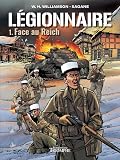
Légionnaire — Face au Reich
Bande dessinée retraçant le parcours de légionnaires français confrontés à l'Allemagne nazie durant la Seconde Guerre mondiale.
View on Amazon →Amazon affiliate link
1944 – 1951
From 1944 to 1951, find the battles led by this commander below, with the opponent, outcome and consequences for each.
The Battle of the Belfort Gap was a decisive operation conducted by the French 1st Army to open access to Alsace in November 1944. Across difficult terrain combining mountains, forests, and fortified positions, French troops managed to break through the German lines through the famous 'gap,' a natural axis between the Vosges and the Jura. This victory marked a major strategic advance and paved the way for the liberation of Mulhouse and Strasbourg.
The Battle of Mulhouse pitted French forces of the 1st Army against a German garrison entrenched in the industrial city of Alsace. The objective was to consolidate the advance begun after the breakthrough of the Belfort Gap and secure access to the Rhine. The battle was brief but intense, with violent street fighting, particularly around the industrial facilities. The city was liberated on 24 November.
The Battle of the Colmar Pocket is one of the last major operations of the Liberation on French soil. It aimed to dislodge German forces entrenched in the Haut-Rhin, who still held the entire Colmar plain. Led by General de Lattre, the French 1st Army conducted intense fighting under extreme winter conditions. After nearly three weeks of fierce struggle, Colmar was liberated on 2 February 1945.
The city of Constance, on the Swiss border, was captured by the French 1st Army on 26 and 27 April 1945 without major resistance. The city, fearing destructive fighting, negotiated a swift surrender with French officers. The German forces present, disorganized and demoralized, offered only weak resistance, facilitating the strategic capture of this border point.
At the end of March 1945, the French 1st Army crossed the Rhine at Germersheim and Speyer, after having secured Alsace. This amphibious operation marked the entry of French troops into German territory, a first since 1918. Under the command of General de Lattre, engineers crossed the river under enemy fire, supported by effective artillery and aviation.
The Battle of Hòa Bình, the longest large-scale operation conducted by the French army during the Indochina war, aimed to cut the Việt Minh off from its logistical bases in the northwest and to draw its main units into a positional battle favorable to the French. The initial offensive succeeded in seizing Hòa Bình, but Giáp's repeated counterattacks, the isolation of French posts, and the difficulty of the terrain forced a costly withdrawal. The toll was bloody on both sides, without a decisive victory.
The Battle of Mao Khé pitted French forces against two Việt Minh divisions launched in an assault on the strategic mining sector of Route 18. The fighting was fierce, particularly around the town of Mao Khé and the surrounding hills. Despite the Việt Minh's numerical superiority, the rapid intervention of French reserves, air support, and artillery allowed the offensive to be broken. This dearly won victory consolidated the defense of the delta and delayed the Việt Minh advance toward Haiphong.
The Battle of Vĩnh Yên marks a turning point in the Indochina war: for the first time, the Việt Minh massively committed two divisions against a fortified French position in the delta. The initial attack forced the French to retreat, but the arrival of General de Lattre and the massive use of armor and aviation reversed the situation. After several days of fierce fighting, the Việt Minh offensive was broken and the French position consolidated.
Shop suggestion
Bande dessinée retraçant le parcours de légionnaires français confrontés à l'Allemagne nazie durant la Seconde Guerre mondiale.
View on Amazon →Amazon affiliate link