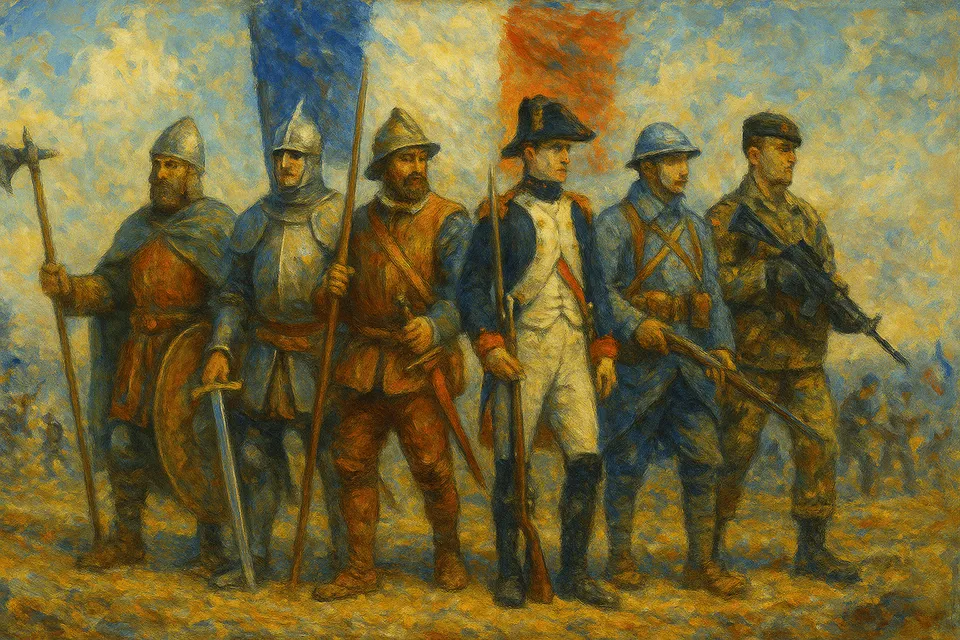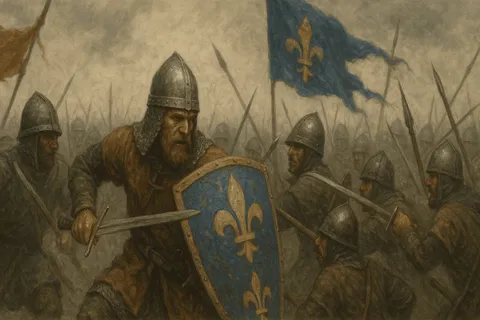
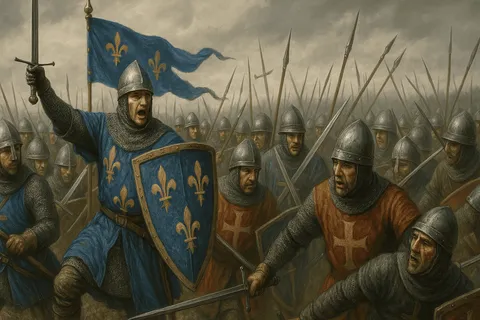
French soldiers of the era: Early Middle Ages

~476 – 987

Early Middle Ages

Birth of the Frankish kingdom, Clovis's conquests, and major battles such as Poitiers (732), marking the decisive halt of Muslim expansion into Europe.
Troop types & units

Frankish warrior
Free foot soldier forming the core of the Merovingian army.
Antrustion
Elite warrior bound by oath to a chief, an early ancestor of feudal vassalage.
Carolingian horseman
Under Charlemagne, heavy cavalry became the decisive arm of the Frankish army.

Weapons & armour

Francisca
Iconic throwing axe of the Frankish warriors.
Seax
Long single-edged fighting knife, a common secondary weapon.
Spatha sword
Long double-edged sword inherited from late Roman military equipment.
Round shield
Wooden shield with an iron rim, often painted or decorated.
Spear
The most common polearm, used both on foot and on horseback.
See the battles of this era →
French soldiers of the era: High Middle Ages

987 – 1328

High Middle Ages

The height of feudalism and the Crusades, marked by emblematic battles such as Hastings (1066), Bouvines (1214), and French military expeditions to the Holy Land.
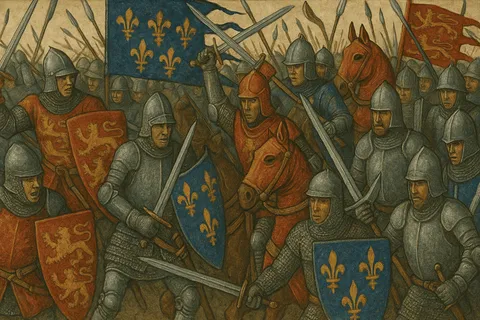
Troop types & units

Knight
Mounted noble warrior, trained from childhood in mounted combat.
Sergeant-at-arms
Mounted or foot combatant of common birth, framing the feudal levies.
Crossbowman
Specialised infantryman feared for his weapon's range and power.
Town militia
Foot soldiers raised by towns to secure their own defence.

Weapons & armour

Mail hauberk
Chainmail covering the torso, arms and sometimes the legs.
Great helm
Fully enclosed helmet protecting the whole face.
Arming sword
The knight's noble weapon par excellence.
Knight's lance
Long lance used in mounted charges.
Crossbow
Mechanical ranged weapon capable of piercing mail.
See the battles of this era →
French soldiers of the era: Late Middle Ages

1328 – 1492

Late Middle Ages

The Hundred Years' War between France and England, marked by the heroic epic of Joan of Arc and emblematic battles at Agincourt (1415), Orléans (1429), and Castillon (1453).
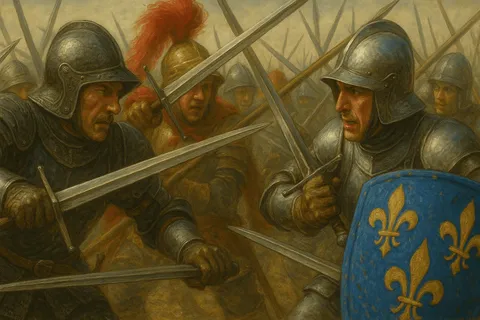
Troop types & units

Gens d'armes
Professional heavy cavalry of the standing companies created by Charles VII in 1445.
Franc-archer
Peasant archer raised by parish, exempted from taxes in exchange for military service.
English longbowman
The iconic opponent of the Hundred Years' War, armed with the feared longbow.
Pikeman
Foot soldier equipped with long polearms to counter cavalry charges.

Weapons & armour

Plate armour
Articulated steel armour, the pinnacle of medieval personal protection.
Longbow
English rapid-fire, long-range weapon, decisive at Agincourt.
Cranequin crossbow
Improved crossbow, more powerful but slower to reload.
Couleuvrine
The first gunpowder artillery deployed on French battlefields.
Two-handed sword
Thrusting and cutting weapon designed to pierce heavy armour.
See the battles of this era →
French soldiers of the era: Renaissance

1492 – 1610

Renaissance

A period of cultural renewal and major conflicts such as the Italian Wars, marked by emblematic battles at Marignano (1515) and Pavia (1525), affirming the power of Francis I.
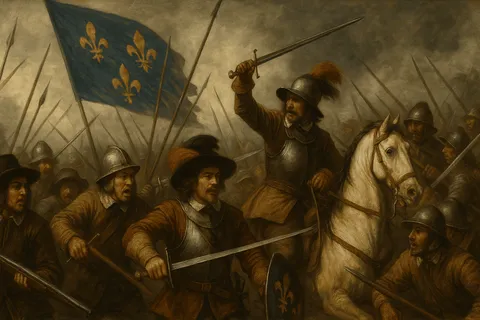
Troop types & units

Gendarme
Heir to the gens d'armes, noble heavy cavalry typical of the Italian Wars.
Landsknecht and reiter
German mercenaries hired in large numbers by the French crown.
Pikeman
Foot soldier fighting in tight formation, the backbone of the infantry.
Arquebusier
Foot soldier armed with a portable firearm, a rising force on the battlefield.

Weapons & armour

Arquebus
The first widely used portable firearm in Europe.
Pike
Long infantry spear, up to 5–6 metres in length.
Rapier
Fine sword intended for duelling and close combat.
Three-quarter armour
Lightened plate armour, adapted to the growing threat of firearms.
Bronze cannon
Increasingly mobile and accurate siege artillery.
See the battles of this era →
French soldiers of the era: Classical Era

1610 – 1789

Classical Era

Consolidation of absolute monarchy under Louis XIV and landmark battles such as Rocroi (1643) and Fontenoy (1745), affirming France's military power in Europe.
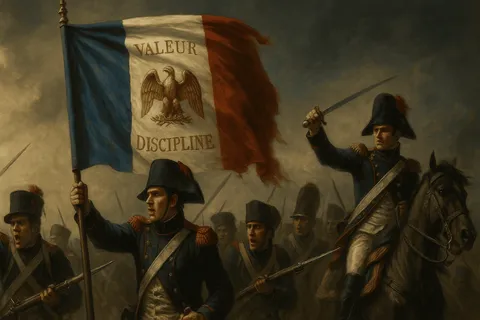
Troop types & units

Musketeer
Elite infantryman armed with a musket, famed as the king's close guard.
Royal infantry regiment
Permanent, professional unit born from Louvois's military reforms.
Dragoon
Light cavalry able to fight both mounted and on foot.
Gardes françaises
Elite regiment tasked with the king's close protection.

Weapons & armour

Flintlock musket
Standard individual firearm of the royal infantry.
Bayonet
Blade fixed to the musket barrel, turning the firearm into a polearm.
Officer's sword
Weapon of command, parade and duel.
Vauban-pattern cannon
Siege artillery refined to support Vauban's fortifications.
See the battles of this era →
French soldiers of the era: Revolution & Empire

1789 – 1815

Revolution & Empire

An era shaped by the French Revolution and Napoleon's Empire, revolutionising the art of war with famous battles at Austerlitz (1805), Jena (1806), and Waterloo (1815).
Troop types & units

Grognard of the Imperial Guard
Elite veteran of the Old Guard, a symbol of Napoleon's army.
Cuirassier
Heavy cavalry protected by a steel cuirass, used in decisive charges.
Voltigeur
Light infantry tasked with skirmishing and opening the battle.
Hussar
Fast light cavalry specialised in reconnaissance and pursuit.
Army corps
Large combined-arms unit invented by Napoleon, grouping infantry, cavalry and artillery under one command.

Weapons & armour

Model 1777 musket (Charleville)
Standard flintlock musket of the Grande Armée's infantry.
Bayonet
Still essential for close combat in tight formation.
Cavalry sabre
Curved blade suited to the charge and mounted combat.
Gribeauval cannon
Standardised artillery system, a major asset of Napoleon's strategy.
See the battles of this era →
French soldiers of the era: Modern Era

1815 – 1914

Modern Era

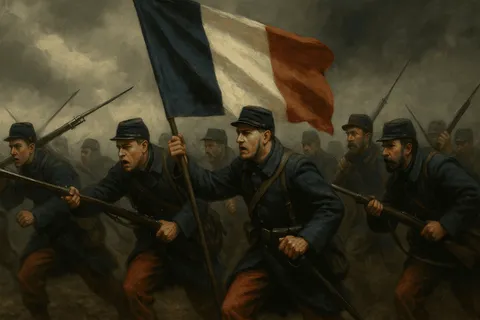
Colonial wars, campaigns in Africa and Asia, and European conflicts such as the Crimean War (1854) and the Franco-Prussian War (1870).
Troop types & units

Zouave
Light infantry unit of colonial origin, famed for its distinctive uniform.
Colonial rifleman (tirailleur)
Soldiers recruited from France's colonies in Africa and Indochina.
Alpine chasseur
Elite mountain infantry created in 1888.
Cuirassier
Heavy cavalry surviving as a parade and combat unit until 1914.

Weapons & armour

Chassepot rifle
The French army's first breech-loading rifle (1866).
Lebel rifle
Repeating rifle, the first in the world to use smokeless cartridges (1886).
Machine gun
Emerging automatic weapon that would transform the battlefield.
75mm field gun
Famous rapid-fire cannon, a symbol of modern French artillery.
See the battles of this era →
French soldiers of the era: Contemporary Era

1914 – today

Contemporary Era

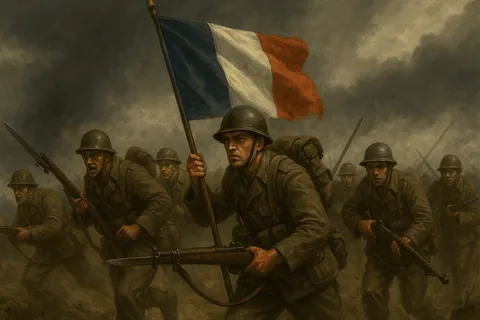
From the First World War to the present day, this period covers the great world battles (Verdun, Bir Hakeim, Colmar) and France's modern engagements in international conflicts.

Troop types & units

Poilu
French infantryman of the First World War, a symbol of trench warfare.
Free French soldier
Fighter of the Free French Forces under General de Gaulle's authority.
Legionnaire
Soldier of the French Foreign Legion, deployed across most modern theatres.
Marine commando and paratrooper
Elite troops trained for contemporary special operations.

Weapons & armour

Lebel then MAS-36 rifle
Standard individual weapon across both world wars.
Hotchkiss machine gun
Key automatic weapon of the French army during the First World War.
Renault FT tank
The first modern tank with a fully rotating turret, introduced in 1917.
FAMAS assault rifle
Standard individual weapon of the contemporary French army.
See the battles of this era →

Shop suggestion

Les grandes batailles de l'histoire de France

Vincent Bernard

Un panorama des grandes batailles qui ont marqué l'histoire militaire française, du Moyen Âge à l'époque contemporaine.

View on Amazon →

Amazon affiliate link